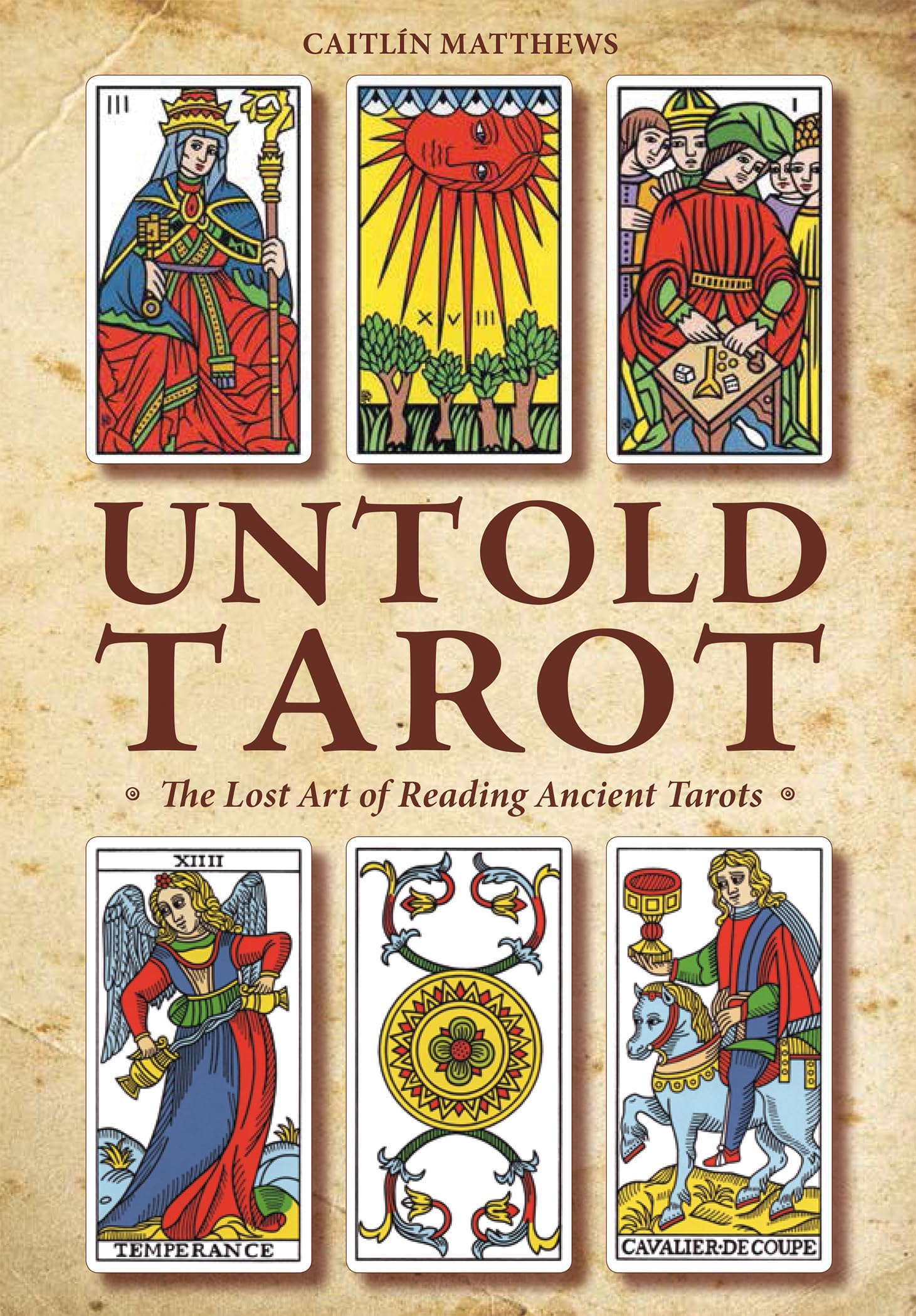
Untold Tarot: The Lost Art of Reading Ancient Tarot
Product ID: 75313523
Buy anything from 5,000+ international stores. One checkout price. No surprise fees. Join 2M+ shoppers on Desertcart.
Desertcart purchases this item on your behalf and handles shipping, customs, and support to Samoa.
Rediscover the forgotten techniques of historical Tarot reading and bring new depth to your practice with ancient tools for modern insight. Untold Tarot by Caitlín Matthews is a groundbreaking guide that revives centuries-old divinatory skills used with historical decks, particularly the Tarot de Marseille. Drawing on cartomantic traditions long overlooked in contemporary Tarot, Matthews teaches methods such as card blending, pairing, line reading, and directional cues—where the characters in the cards are looking—to unlock layered narratives and hidden meanings. Untold Tarot returns to the roots of Tarot reading, offering a historically grounded, yet accessible way to approach pip cards, court personalities, and trumps. It presents detailed explanations of number and suit correspondences and includes traditional spreads drawn from French and Italian sources. • A complete system for reading with the Tarot de Marseille • Techniques for card pairing, directionality, and sight lines • Rich historical context for both trumps and suits • Methods that expand intuitive reading through visual storytelling • Includes examples from historic and modern Marseille decks Written by one of the world’s foremost authorities on Tarot, Untold Tarot is essential reading for those ready to explore Tarot beyond the Rider-Waite tradition—and reclaim the lost art of ancient cartomancy. Review: Delightful and Informative—Instant Classic! - EDIT: I wanted to revisit this title after a lot more experience with it. My respect for the book and it’s author has only grown since I first reviewed it, but there are a couple of things I am going to add. Foremost is: this book is an instant classic worthy of a wide readership. And, if it isn’t clear, this is written primarily out of the French, not the English, school. So, get yourself a “Marseille” Tarot deck. Not that it wouldn’t work with an English deck (not saying it would, either... I’m not sure the il’ RWS clone speaks French!) I noticed Untold Tarot (2018) was published after her Lenormand book, The Complete Lenormand Oracle Handbook (2014). I suspect the book under review benefitted from her research into that system. In any case, having recently begun studying the Lenormand oracle with the other book, much in Untold Tarot is clearer. In fact, her Lenormand book is an excellent companion volume to this one. Caitlin Matthews is reaching back to the most ancient cartomatic traditions—why, as far back as the 18th century! (Sorry if that offends anyone’s romantic ideas about ancient Egyptian wisdom, Cathars or whatever, although the historic origins aren’t really that important.) I think Lenormand is a very good system in its own right. But whether you take it up or stick with Tarot, I think the other book is also worth studying for Tarot de Marseille readings in the French tradition. The second reason I’m here again is to address some frustrations. Past frustrations, I should say, because I get it now. The type of “open reading” (see Yoav Ben-Dov’s excellent book of that name) that stirs everything into the mix and comes out proper tasty relies on intuition. It is ephemeral. It’s not “this card in this position means such-and-such.” Her examples (like the Lenormand exercises in her other book) are often wildly at odds with what I see. But a card or combinations of cards can mean different things on different days in different readings. I hazard to say she wouldn’t disagree with me here. This is a big reason she insists on a properly framed question. (Although casual personal conversations with Tarot are valuable, too, in my view.) The reader should study these as examples of the process. I’m certain I should have realized this earlier. I do have one minor complaint. The author drops tantalizing hints about some tradition that really is “untold,” meaning she does not tell it in this book! For example, on p. 187, we are told that the Ace of Swords and 2 of Swords is “a classic combination about mental health.” While I realize card combinations may depend on many factors, if some are truly “classic,” they should be shared. Where does this “classic” combination come from? How is a reader supposed to follow a hint like that? Or is the use of the word “classic” just a bit inartful? Certainly not a major complaint, but it would be interesting to know more, since she brought it up! This is not “Tarot for Dummies.” This is a rich book by a respected writer, a book backed by careful research and much experience. It is meant to be studied and experimented with. Yes, it might be a bit overwhelming for someone new to Tarot. But the beauty of it is, you don’t have to use every spread, or take every word as gospel. It’s a beginning, not an end. In a strange way, the Untold Tarot remains untold because it cannot be told. Caitlin Matthews is renewing and handing down a tradition of card reading within those limits. I hope she would take it as fair comment that we should pay attention to her experience and wisdom, but the Tarot will forever be “untold” until it unfolds its secrets in its own time and manner to each sincere seeker. Caitlin Matthews is one of the best teachers living. ————— With the well-deserved rediscovery of the Tarot de Marseille we’ve seen more books featuring the deck. This is one of the more interesting. First off, it’s a handsomely produced, slick book fully illustrated with various TdM decks. (Perhaps the lion’s share goes to the excellent CDM tarot, whose clean lines make it a good choice.) I hope someone looking for something else finds his or her way here because if you have, my friend, consider it a special invitation to get a TdM deck and this quite sensible and well-written book. There is quite a bit of good history in here, which surprised me since I was not led to expect as much by the advertising. As for the divergence into the English tarot current... Let’s say the RWS deck is respectfully put into perspective and some of the more creative clones are viewed with a slightly jaundiced eye. From the latest crop of TdM books we expect a good historical, well-sourced treatment, and that’s what the author gives. The trend toward which TdM interpretation is presented is in a looser style which takes into account all sorts of things beyond by-rote meanings and spread positions, and this book is no exception. Line-of-sight interpretation gets a very good treatment. Cards are rarely considered by themselves. There are card-by-card interpretations, hovever, as well as set spreads. On the other hand there are examples of some very open readings. The TdM is very flexible and the book gives full credit to that quality. The TdM defies rules. Anyone who works with it for any length of time will find their own methods. This is the best book for beginners on the TdM I’ve seen. Review: One to refer to often! - This is the best book for reading TdM/pip decks that I've come across. There's a disturbing tendency in Tarot literature - old as well as new - to talk and talk but not give any actual useful information. You don't see that here. This is good, solid cartomancy with a lot on techniques and meanings, along with relevant historical factoids. It's an interesting read, as well as something I will be referring to often - and it's made for this, nicely bound with the pages stitched in! This is not hermetic Tarot, nor is it Jungian or new age. It's old-fashioned European cartomancy, which has become so obscured in this day and age that someone commenting on facebook called it "Lenormand techniques"! Yes, the Lenormand method shares some similar approaches (like directional reading, combining cards, knighting, etc.), as do playing card methods, Kipperkarten, French and Italian Sibilla, etc. - it's just what everybody used to DO in those days. Tarot readers included. It's straightforward, well organized, and includes jewels like, "The Fool shows you what you are not taking seriously, which will be the card he faces" and "Knights bridge or convey something from one card by taking it to the card they face." Reading by number and suit is thoroughly explained, historical documents are referenced, there's plenty of detail but not so much as to make it dull. I've been into cards forever, and I learned things from this book. But it would be good for beginners, as well. It's for anyone with a desire to unlock those lovely old pip Tarots! A much needed breath of fresh air - thank you, Caitlin!
| Best Sellers Rank | #541,618 in Books ( See Top 100 in Books ) #556 in Fortune Telling #1,165 in Tarot |
| Customer Reviews | 4.6 out of 5 stars 188 Reviews |
C**R
Delightful and Informative—Instant Classic!
EDIT: I wanted to revisit this title after a lot more experience with it. My respect for the book and it’s author has only grown since I first reviewed it, but there are a couple of things I am going to add. Foremost is: this book is an instant classic worthy of a wide readership. And, if it isn’t clear, this is written primarily out of the French, not the English, school. So, get yourself a “Marseille” Tarot deck. Not that it wouldn’t work with an English deck (not saying it would, either... I’m not sure the il’ RWS clone speaks French!) I noticed Untold Tarot (2018) was published after her Lenormand book, The Complete Lenormand Oracle Handbook (2014). I suspect the book under review benefitted from her research into that system. In any case, having recently begun studying the Lenormand oracle with the other book, much in Untold Tarot is clearer. In fact, her Lenormand book is an excellent companion volume to this one. Caitlin Matthews is reaching back to the most ancient cartomatic traditions—why, as far back as the 18th century! (Sorry if that offends anyone’s romantic ideas about ancient Egyptian wisdom, Cathars or whatever, although the historic origins aren’t really that important.) I think Lenormand is a very good system in its own right. But whether you take it up or stick with Tarot, I think the other book is also worth studying for Tarot de Marseille readings in the French tradition. The second reason I’m here again is to address some frustrations. Past frustrations, I should say, because I get it now. The type of “open reading” (see Yoav Ben-Dov’s excellent book of that name) that stirs everything into the mix and comes out proper tasty relies on intuition. It is ephemeral. It’s not “this card in this position means such-and-such.” Her examples (like the Lenormand exercises in her other book) are often wildly at odds with what I see. But a card or combinations of cards can mean different things on different days in different readings. I hazard to say she wouldn’t disagree with me here. This is a big reason she insists on a properly framed question. (Although casual personal conversations with Tarot are valuable, too, in my view.) The reader should study these as examples of the process. I’m certain I should have realized this earlier. I do have one minor complaint. The author drops tantalizing hints about some tradition that really is “untold,” meaning she does not tell it in this book! For example, on p. 187, we are told that the Ace of Swords and 2 of Swords is “a classic combination about mental health.” While I realize card combinations may depend on many factors, if some are truly “classic,” they should be shared. Where does this “classic” combination come from? How is a reader supposed to follow a hint like that? Or is the use of the word “classic” just a bit inartful? Certainly not a major complaint, but it would be interesting to know more, since she brought it up! This is not “Tarot for Dummies.” This is a rich book by a respected writer, a book backed by careful research and much experience. It is meant to be studied and experimented with. Yes, it might be a bit overwhelming for someone new to Tarot. But the beauty of it is, you don’t have to use every spread, or take every word as gospel. It’s a beginning, not an end. In a strange way, the Untold Tarot remains untold because it cannot be told. Caitlin Matthews is renewing and handing down a tradition of card reading within those limits. I hope she would take it as fair comment that we should pay attention to her experience and wisdom, but the Tarot will forever be “untold” until it unfolds its secrets in its own time and manner to each sincere seeker. Caitlin Matthews is one of the best teachers living. ————— With the well-deserved rediscovery of the Tarot de Marseille we’ve seen more books featuring the deck. This is one of the more interesting. First off, it’s a handsomely produced, slick book fully illustrated with various TdM decks. (Perhaps the lion’s share goes to the excellent CDM tarot, whose clean lines make it a good choice.) I hope someone looking for something else finds his or her way here because if you have, my friend, consider it a special invitation to get a TdM deck and this quite sensible and well-written book. There is quite a bit of good history in here, which surprised me since I was not led to expect as much by the advertising. As for the divergence into the English tarot current... Let’s say the RWS deck is respectfully put into perspective and some of the more creative clones are viewed with a slightly jaundiced eye. From the latest crop of TdM books we expect a good historical, well-sourced treatment, and that’s what the author gives. The trend toward which TdM interpretation is presented is in a looser style which takes into account all sorts of things beyond by-rote meanings and spread positions, and this book is no exception. Line-of-sight interpretation gets a very good treatment. Cards are rarely considered by themselves. There are card-by-card interpretations, hovever, as well as set spreads. On the other hand there are examples of some very open readings. The TdM is very flexible and the book gives full credit to that quality. The TdM defies rules. Anyone who works with it for any length of time will find their own methods. This is the best book for beginners on the TdM I’ve seen.
****
One to refer to often!
This is the best book for reading TdM/pip decks that I've come across. There's a disturbing tendency in Tarot literature - old as well as new - to talk and talk but not give any actual useful information. You don't see that here. This is good, solid cartomancy with a lot on techniques and meanings, along with relevant historical factoids. It's an interesting read, as well as something I will be referring to often - and it's made for this, nicely bound with the pages stitched in! This is not hermetic Tarot, nor is it Jungian or new age. It's old-fashioned European cartomancy, which has become so obscured in this day and age that someone commenting on facebook called it "Lenormand techniques"! Yes, the Lenormand method shares some similar approaches (like directional reading, combining cards, knighting, etc.), as do playing card methods, Kipperkarten, French and Italian Sibilla, etc. - it's just what everybody used to DO in those days. Tarot readers included. It's straightforward, well organized, and includes jewels like, "The Fool shows you what you are not taking seriously, which will be the card he faces" and "Knights bridge or convey something from one card by taking it to the card they face." Reading by number and suit is thoroughly explained, historical documents are referenced, there's plenty of detail but not so much as to make it dull. I've been into cards forever, and I learned things from this book. But it would be good for beginners, as well. It's for anyone with a desire to unlock those lovely old pip Tarots! A much needed breath of fresh air - thank you, Caitlin!
N**S
Excellent TdM Resource
A concise, utilitarian treatment of pre 18th century cartomantic approaches to interpreting Marseilles / unillustrated pip style tarots. a wealth of practical information and tools not seen in other books in here, definitely enhanced my ability to read TdM decks, particularly rich with useful approaches to interpreting the court cards. Although Jodorowsky and Ben-Dov don't concern themselves much with historical precedent I do for the most part admittedly prefer a blend of the the pip attributions they offer in their respective books, which seem to me more sensibly related to imagery on the cards, rather than the perhaps historically based but nonetheless often random seeming attributions offered in "Untold Tarot". Of course if you have a serious ambition to work with Marseilles tarots you'll want to read everything available and reach your own conclusions about what makes sense and works for you, but definitely include this book on your reading list since it offers a lot of unique and highly practical information so far as I'm aware nowhere else accessibly described in the present body of english language tarot literature, excellent stuff! (also as others have mentioned the binding and tactile qualities of this book exceed expectations)
G**L
Much needed book!
This book, "Untold Tarot" by Caitlin Matthews, fills what had been a big gap in the literature on the Tarot de Marseille. While there are a few other excellent books out there, I feel this book is more down to earth and practical, offering a variety of different ways to read the Marseille deck with more historical accuracy and less personal idiosyncrasy than some. The book is also beautifully produced, on quality paper with a profusion of color illustrations and charts. The only "negative" is that while Ms. Matthews offers detailed descriptions of each of the Major Arcana cards, the cards she selected to illustrate each of the Majors sometimes don't match her description. This matters in situations, for example, when instructions for reading a card refer to the way the figure is facing, while the pictured card figure faces another way. Or when an object they are holding is supposed to be significant, and the picture differs from that. I appreciate that she is giving us the opportunity to view a variety of Marseilles decks, but it's a little confusing. I might have preferred that she choose one representative deck for this, with perhaps a section in the back with some pictures of alternate decks. Nevertheless, it's an excellent book, and leaves me feeling I don't really need another. Of my several books on the Tarot de Marseille, this will be my go-to guide.
A**A
Really good book for learning Marseilles Tarot.
This is actually the second copy of this book I purchased in the last 5 years, I misplaced the other, but it is an invaluable reference, so I thought it couldn't hurt to have two. Highly recommend for learning Marseille and Pip card type Tarot.
W**A
Helpful
I'm not surprised that Caitlin has done it again. Caitlin's book is a gift and a treasure. It preserves the wonderful legacy of forgotten traditions, setting them back in their rightful place as the authentic ways of seeing and using the Tarot. I highly recommend this book to anyone who wants a more authentic connection and experience with the Tarot cards, and more importantly, with themselves and their loved ones.
T**T
Incredibly Clear, Direct Resource
This book is an incredibly clear & direct guide to 'traditional' (in the sense of not derived from ceremonial magic) methods of reading the Tarot de Marseille and playing cards. I appreciated Matthews' knowledgeable and no-nonsense tone; she imparts considerable research, insight, and experience without any of the self-aggrandizement or wifty 'woo' that can plague the genre. An excellent resource.
K**C
Brilliant!
Well written, well laid out, tons of information. If you are at all interested in the Tarot, this book is not to be missed. I'm hoping it will later be made into an ebook as the print is very small - but well worth squinting to read it.
C**Y
Perfect Companion to the Marseille Tarot
I loved this book. I've been reading the tarot for years, yet this book had to offer me new information. It's a perfect companion if you're new to the Marseille tarot like me. You'll learn a lot of transferable skills you can use for other decks, such as the Ride-Waite-Smith.
T**S
Old Ways of Reading the Tarot Revisited
In recent years, interest in reading tarot using such decks as the Tarot de Marseille has been steadily growing. For anyone wishing to explore this way of reading, where spot cards lack the sort of illustrations one finds in the Waite-Smith deck, this book is a timely godsend. It is well-researched and beautifully illustrated with cards from a dozen or so continental tarots. Caitlín Matthews explains each trump individually from the divinatory angle, and ably demonstrates how predictive meanings are arrived at for spot cards bearing little in the way of ornamentation beyond the requisite number of suit signs – three goblets on the 3 of Cups, seven swords on the 7 of Swords, and so forth. I was introduced to tarot reading in the ’50s, before the ascendancy of the Waite-Smith deck, and much presented here is familiar to me. Many of these methods were in use back then. Even the Hermetic Order of the Golden Dawn, founded in the late Victorian era, took the direction in which the card representing the inquirer faced as the direction in which the cards were to be read. Techniques such as these have largely fallen into disuse and I applaud their being brought back to tarot readers’ attention. A breadth of methodologies is laid out for the reader to try out. The author suggests working with them all and retaining those one clicks with. I, certainly, found some more suited to my temperament and approach to readings than others. No matter, for the author supplies a wealth of approaches. The techniques are well explained and nicely illustrated using spreads from Caitlín Matthews’ personal casebook. For anybody drawn to traditional reading methods prior to the publication of the Waite-Smith deck, ‘Untold Tarot’ will be an invaluable addition to their bookshelf.
A**D
Amazing
Fantastic book. A must have for vintage tarot enthusiasts. The book is broken into easy to read sections with tips on how to read specific types of cards, making it very easy to digest even though it's a very large subject matter. Caitlin Matthews has done it again!
C**E
Meilleur livre sur la lecture du tarot de Marseille
À lire et à relire ! C'est un ouvrage de référence et mon préféré de tous sur le système du tarot de Marseille. Une belle recherche historique approfondie qui donne des références de documents historiques sur l'usage divinatoire des cartesau 15e siècle! Les explications sont claires, les analyses développées, les tirages traditionnels sont étonnants et superbes et les correspondances entre numerologie et couleurs sont très bien développées. C'est le meilleur ouvrage sur le sujet à mon avis et très pédagogique. Dommage qu'il n'y ait pas de traduction en français.
H**D
Ideal
Excelente si quieres saber de historia y más sobre la interpretación clásica en lugar de saturarte de significados rígidos.
Trustpilot
1 month ago
2 weeks ago