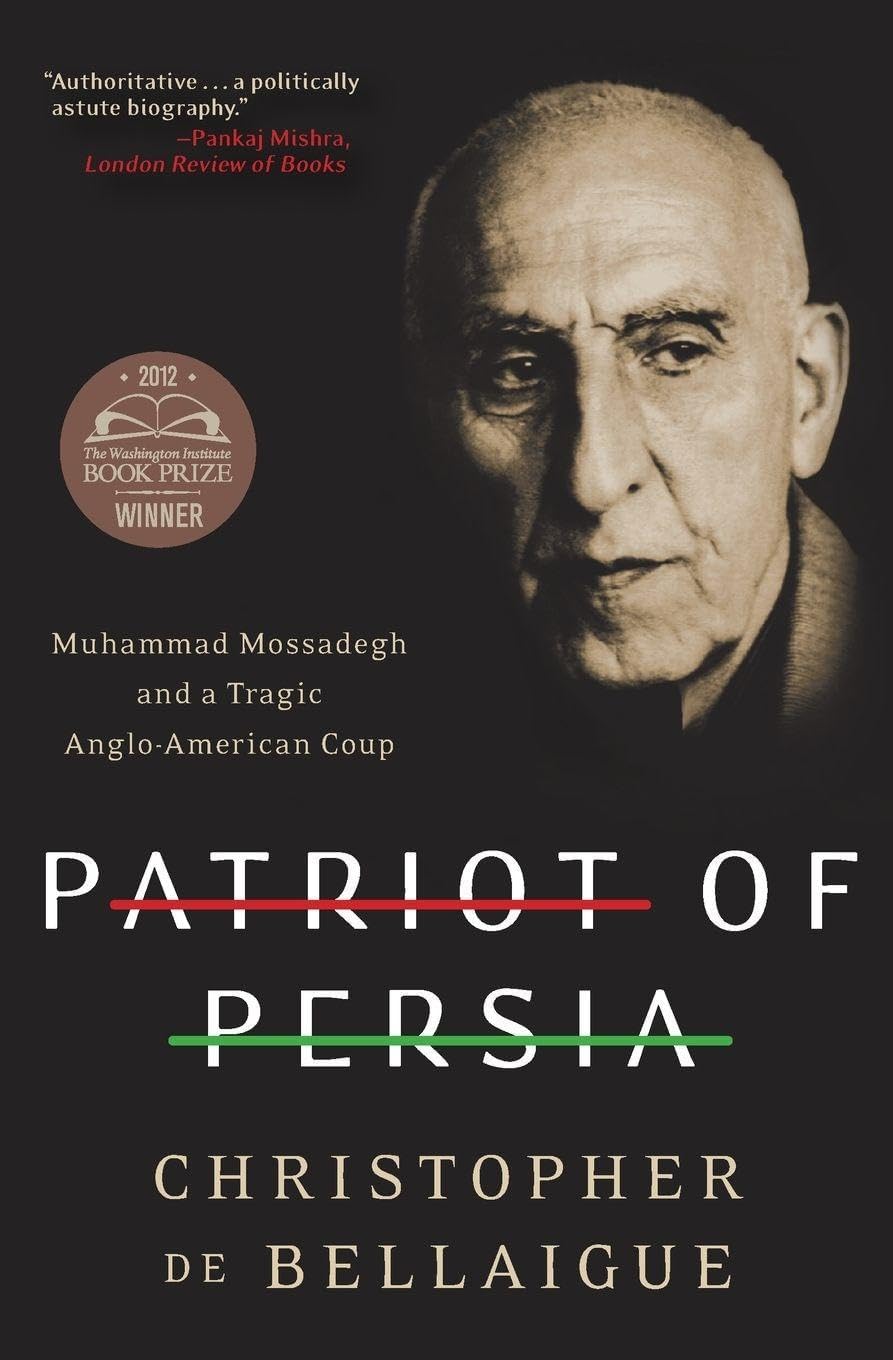
Patriot of Persia: Muhammad Mossadegh and a Tragic Anglo-American Coup – The First Biography of a Misunderstood Icon and Middle East Hero
Product ID: 4123303
Buy anything from 5,000+ international stores. One checkout price. No surprise fees. Join 2M+ shoppers on Desertcart.
Desertcart purchases this item on your behalf and handles shipping, customs, and support to Samoa.
The Economist ’s Tehran correspondent Christopher de Bellaigue brings to light the never-before-told full story of one of the great anti-colonial heroes of the twentieth century: Muhammad Mossadegh, the great Iranian leader whose untimely demise resulted in the Islamic Revolution of 1979, and a man who has been demonized, ridiculed, and misunderstood in the West while remaining an icon and an inspiration across the Middle East. Patriot of Persia , the first biography exploring his life and impact, opens a crucial new window into Mossadegh—whose role in the evolution of Iran’s political climate cannot be overemphasized—providing a resource that will prove equally invaluable to academics, newshounds, and activists as they struggle to understand Mideast politics, Iran, Ahmadinejad, and the future of the region—and the world. Review: Well written and highly informative - The is a well written and highly informative biography of Muhammad Mossadegh, which concentrates on the 1953 fall of his government of Iran. The book captures Mossadegh’s highly idiosyncratic life and his impact on Iran and on the history of the 20th century. The book is a complete biography, covering his early life and education France and Switzerland, and his early political life leading up to his becoming the Iranian prime minister. The emphasis is, however, on his tenure as prime minister and on the coup that drove him from power. While the book clearly favors Mossadegh side of events, he is also criticized as having contributed to his own downfall. While the US and Britain are held responsible for the 1953 coup, the book also shows how others, - the leaders of the religious establishment, the communist Tudeh party,royalist elements in the army, and Mossadegh’s indecisive leadership in the crisis all led to the fall of his government. Mossadegh is described as a man who could not compromise on his beliefs, even when a short-term compromise would have likely fostered his long-term goals. He was focused on the British control over the oil fields of Iran, but refused to accept a deal that, while not 100% of what he wanted, would have given Iran almost all of what he wanted and would have alleviated a severe economic crisis. He is pictured as a man prone to dramatic gestures, but indecisive when action was critically called for. I liked the book a lot and found that it gave me a better understanding of the 1979 Iranian Revolution that was in effect a continuation and result of the events of 1953. The book contains photographs, but in this paperback edition they are printed on the same course paper as the rest of the book and are therefore quite indistinct and rather useless. It has a bibliography, notes and an index. Review: Excellent! - de Bellaigue has written an exceptional book. Although there's a good bit about the coup that took down Mossadegh, the book's focus is greater than that. It serves as a lesson on Iranian politics from the 30's to the 50's and it gives a good glimpse of life and politics at the time. The British do not, of course, come out of it looking good, neither do the Americans, who even going against the advice of some of its own more enlightened foreign service men, lets the British fool them into a coup that did not benefit American interests. That it later led to the '79 Revolution and the Iran of today is even more tragic. It also helps the reader who does not know the real history of the area to understand the deep mistrust and oftentimes hatred of the US and the UK that can be found in some Iranian circles. Sometimes is hard to think them wrong. It is tragic to see that had the US taken a different path, the history of the Middle East could have been different. BUT, and it's a big but, de Bellaigue does not tell an one-sided story. He criticizes Mossadegh on many occasions and points out on others how his behavior helped, in the end, the positions taken by the US and the British. Had he been more politically able on the international scene, he could have helped his cause a lot. So it is a balanced book, which gives praise and criticism on the right places. It does not make an excuse for anything that came after or during that time. That the author has real experience living in Tehran is a welcome bonus, since some books about this period have been written by people with fairly limited real experience of Iran. It is a recommended reading for today, since Iran is back on the news for the wrong reasons and it, at least, shows the reader that meddling in other countries carries long term consequences that can hardly be foreseen. It is also a tale of how a country can do something so contrary to it's values and principles (the US and UK) while the 'victim' also fumbles the ball and helps the cause against it, sometimes out of political ineptitude. A sad, but real and very interesting tale.
| Best Sellers Rank | #341,626 in Books ( See Top 100 in Books ) #50 in Iran History #384 in Middle Eastern Politics #1,045 in History & Theory of Politics |
| Customer Reviews | 4.4 out of 5 stars 151 Reviews |
M**T
Well written and highly informative
The is a well written and highly informative biography of Muhammad Mossadegh, which concentrates on the 1953 fall of his government of Iran. The book captures Mossadegh’s highly idiosyncratic life and his impact on Iran and on the history of the 20th century. The book is a complete biography, covering his early life and education France and Switzerland, and his early political life leading up to his becoming the Iranian prime minister. The emphasis is, however, on his tenure as prime minister and on the coup that drove him from power. While the book clearly favors Mossadegh side of events, he is also criticized as having contributed to his own downfall. While the US and Britain are held responsible for the 1953 coup, the book also shows how others, - the leaders of the religious establishment, the communist Tudeh party,royalist elements in the army, and Mossadegh’s indecisive leadership in the crisis all led to the fall of his government. Mossadegh is described as a man who could not compromise on his beliefs, even when a short-term compromise would have likely fostered his long-term goals. He was focused on the British control over the oil fields of Iran, but refused to accept a deal that, while not 100% of what he wanted, would have given Iran almost all of what he wanted and would have alleviated a severe economic crisis. He is pictured as a man prone to dramatic gestures, but indecisive when action was critically called for. I liked the book a lot and found that it gave me a better understanding of the 1979 Iranian Revolution that was in effect a continuation and result of the events of 1953. The book contains photographs, but in this paperback edition they are printed on the same course paper as the rest of the book and are therefore quite indistinct and rather useless. It has a bibliography, notes and an index.
F**S
Excellent!
de Bellaigue has written an exceptional book. Although there's a good bit about the coup that took down Mossadegh, the book's focus is greater than that. It serves as a lesson on Iranian politics from the 30's to the 50's and it gives a good glimpse of life and politics at the time. The British do not, of course, come out of it looking good, neither do the Americans, who even going against the advice of some of its own more enlightened foreign service men, lets the British fool them into a coup that did not benefit American interests. That it later led to the '79 Revolution and the Iran of today is even more tragic. It also helps the reader who does not know the real history of the area to understand the deep mistrust and oftentimes hatred of the US and the UK that can be found in some Iranian circles. Sometimes is hard to think them wrong. It is tragic to see that had the US taken a different path, the history of the Middle East could have been different. BUT, and it's a big but, de Bellaigue does not tell an one-sided story. He criticizes Mossadegh on many occasions and points out on others how his behavior helped, in the end, the positions taken by the US and the British. Had he been more politically able on the international scene, he could have helped his cause a lot. So it is a balanced book, which gives praise and criticism on the right places. It does not make an excuse for anything that came after or during that time. That the author has real experience living in Tehran is a welcome bonus, since some books about this period have been written by people with fairly limited real experience of Iran. It is a recommended reading for today, since Iran is back on the news for the wrong reasons and it, at least, shows the reader that meddling in other countries carries long term consequences that can hardly be foreseen. It is also a tale of how a country can do something so contrary to it's values and principles (the US and UK) while the 'victim' also fumbles the ball and helps the cause against it, sometimes out of political ineptitude. A sad, but real and very interesting tale.
D**N
A Forensic Examination of the Rise and Fall of Muhammad Mossadegh, Premier of Iran
This book relates the life and overthrow of Muhammad Mossadegh, the democratically elected Prime Minister of Iran in August 1953. The book is interesting in that it analyses the life and career of Mossadegh in forensic detail, and in doing so tells us much about the history, politics and social customs of Iran between the turn of the century and 1960. The book is a highly valuable piece of work mainly for this reason. Despite having to grapple with a host of Iranian names and characters I felt I had learnt a lot about the country and could appreciate better why modern Iran adopted some of its present postures. I remain unconvinced that the coup that took place, which is described in moment by moment detail, was actually Anglo-American. Whilst British diplomats certainly frequently expressed their desire to be rid of Mossadegh because of his intransigence in negotiations over the British restarting of oil extraction and refining facilities at Abadan after nationalisation by the Mossadegh government, that does not make them co-conspirators. As far as I can understand from the evidence presented by the author, no British diplomats or agents were in Tehran at the time of the coup. It appears to me to be an entirely American affair, and they were certainly short term beneficiaries from the restoration of the Shah and his subsequent dictatorship. American companies were subsequently heavily involved in the Iranian oil business. The coup was in line with the Dulles-Eisenhower policy of the time to combat the perceived threat of communism on all fronts. Certainly, the chaos promoted by the actions of Mossadegh facilitated a much more prominent role for the Tudeh (Communist) Party and its Soviet backers in Iran which would have been a cause for alarm. The book is clearly the result of copious research and for the most part reads well. However, the story of the premiership of Mossadegh can become a little tedious as he was a difficult and infuriating politician to deal with and it is a tale of frequent lost opportunities. Probably the benchmark work in English on Mossadegh and recommended for all interested in the history and background of modern Iran.
J**D
Clear and sensitive portrayal of Mohammad Mossadegh
Helpful sorting out timelines and events of such a remarkable man. Bellaigue seems to have known Mossadegh though he is not biased to show favoritism in telling us honestly of the emotional state and character Mossadegh had; his strengths and weaknesses. I felt like I was walking Tehran with the author, he the guide, revealing his heart to me about this hero. Mossadegh was a classic example of a true visionary in the early 20th Century striving for change in a land where customs and religion run deep and most often difficult to understand. His education in France and Switzerland gave him the radical perspective on life embracing Democratic values and Statesmanship without being overly religious simply practical in faith. He bravely offered new ideas to the people of Persia who will indeed love him forever. He definitely wanted only the best for Iran and despised the Western philos modus operandi (particularly British) in friction leveraging for oil domination which in his mind was clearly unthinkable. In hindsight it is always easy to say 'see' But as we all well know now just how established oil cartels do not ever play fair, are violent and ruthless in their business, yet Mossadegh defied them trying everything in his power to give Iran the upper hand to balanced negotiation. Great book
S**E
Ongoing Shock Waves Emanating from the Western-Backed Overthrow of Muhammad Mossadegh
Christopher de Bellaigue narrates with much objectivity the life of Muhammad Mossadegh, a Western-educated Iranian liberal reformer whose ultimate goal was to make Iran both economically and politically independent from the West. The narration greatly benefits from Mr. de Bellaigue's intimate knowledge of both British and Iranian cultures. Iran (also known as Persia) was a pawn in the Great Game, i.e., the commercial and military rivalry/conflict that existed between the British Empire and the Russian Empire (subsequently the Soviet Union) for supremacy in Central Asia. During his stint as Prime Minister of Iran from 1951 to 1953, Mr. Mossadegh's highest priority was to nationalize the Iranian assets of the Anglo-Iranian Oil Company (AIOC) (today known as British Petroleum or BP) so that his country would receive a fair share of the proceeds from the extraction and sale of oil. The Iranian oil industry had been under British control since 1913. Mr. Mossadegh wanted friendship with the West based on mutual respect and independence. Great Britain, a fast declining empire whose finances were shaky in the aftermath of WWII, considered these assets essential for its solvency. Mr. de Bellaigue clearly explains to his readers how Great Britain convinced the U.S. to take its side in its quarrel with Iran to overthrow Mr. Mossadegh and to reestablish his more pliable rival, Shah Muhammad-Reza Pahlavi. The involvement of the U.S. in this coup d'état cannot be understood without the context of the Cold War that the U.S. and the Soviet Union waged for decades after the end of WWII. Mr. de Bellaigue rightly observes that this coup inaugurated a U.S. policy in support of shoddy Middle Eastern despots in the ensuing decades. This policy suffered its first major setback in 1979 with the arrival of the Mullahs to supreme power in Iran. The ongoing Arab Spring could result into other major setbacks for American interests in the Middle East. This movement, whose ultimate outcome is hard to predict at this stage, is affecting not only American clients, but also American adversaries such as Iran and Syria. In summary, the overthrow of Mr. Mossadegh serves as a warning to whoever wants to meddle in the affairs of the unpredictable, volatile Middle East.
D**B
Interesting, particularly for the light it sheds on Mossadegh's ...
Interesting, particularly for the light it sheds on Mossadegh's family background and early life, as well as for the way it captures the essence of Iranian culture and politics. But de Bellaigue's style of writing is at times eccentric and over literary. This gets in the way of understanding what is already a complicated enough story.
B**M
An Excellent Biography Of A Great 20th Century Political Personality
Very few people in the west know about Dr Mossadegh. Simply he was a great man, a patriot and an honest politician that was rare during his time and even rarer now. The proof of this is the love and respect that is bestowed on him by the majority of Iranians then and even now after over 60 years. By writing this biography Christopher de Bellaigue has provided insight into the personality and political life of Dr. Mossadegh and the circumstances that led to the nationalization of Iranian oil industry and his unfortunate and subsequent overthrow by CIA under pressure from the British government. In addition this book provides valuable information about socioeconomic circumstances during those crucial years in Iranian history and the deepening of Iranian miss-trust of the foreign powers particularly of the British and American that lingers on to the present day. One can possibly relate the present crises in the region as a result of the foreign powers meddling in the affairs of the developing nations solely for financial gains and through supporting and establishing corrupt and poppet governments without concern for the oppressed population of that country. This is simply a historic crime by British/American governments of the time. Through efforts by the writer of this excellent book and other historians what happened in those dark years will not be forgotten and more importantly it may serve to prevent such misguided policies being repeated in future.
P**J
Persia a Microcosm of Arrogance and Ignorance
A must read for American Patriots who believe that we are the "Temple on the Hill" and a shining example for all the world. We need to learn!!! Notice the wars that we started and the hundreds of thousands human beings murdered. Our most famous leaders of the Western World, Churchill and Eisenhower "tread where fools fear to tread", their ignorance and arrogance created some of the greatest monsters of the 20th century. Just to name a few, Shah of Iran, Popa Doc, Somoza, Trujillo, the house of Saud, Saddam Hussein and the list goes on ad nauseam. Our leaders do not learn, just to name Bush who fooled the people of the United States into a criminal enterprise in Iraq. This book is very good except in several places where it lost my interest. However it was an informative read from a knowledgeable and an erudite writer.
A**R
The way you walk to your execution is what remains
‘Good days and bad days go past. What stays is a good name or a bad name’ (Mossadegh’s advise to Mohammed Reza Shah) This is a highly recommended book if you are interested in the subject, not just Mohammad Mossadegh, but also if you want to understand Iran in relevance of what is taking place today. The author is a Britisher married to an Iranian, and the book is well-written, fast-moving, easy to understand, and it provides great insight not only in how the historical events unfolded, tracing Iranian history as it accompanied the life of Mohammad Mossadegh. Of course, the most important part is the days of nationalist government formation, which led to the nationalization of Iranian oil and a dispute with the United Kingdom, who at that time was a declining colonial power, but still much more powerful than Iran was. The author provides very valuable analysis of the events as well as about the character and actions of Mohammad Mossadegh. The book is relatively unbiased. I would say relative because I never forget the words of George Orwell. ‘Consciously or unconsciously everyone writes as a partisan. Beware of my partisanship, my mistakes of facts and distortion inevitably caused by my seeing only one corner of events.’ Mossadegh comes out as a complex character, and the author does not shy away from criticizing him where this criticism is due. His stubbornness and indecisiveness, as well as errors of judgment in selecting and trusting people led to his inevitable downfall. However, above all, the reason for his downfall was his pacifist and kind nature. He was not a man fit for the violent Iranian society, for he shied away and abhorred bloodshed. Multiple times, he had the opportunity to resort to violence in dealing with his opponents, but he refused to do so, even after the 15th of August failed coup attempt when most of the conspirators were within his control. But he refused to deliver summary punishment to them. He refused to close the US embassy, which was where the conspiracy had been hatched. And he refused to ask the military units loyal to him to suppress the demonstrations and violence by the thugs that was orchestrated by theAmericans following the failed coup of 15th August. One of his closest associates Hossein Fatemi remarked in frustration after failing to convince Mossadegh to execute conspirators after the failed coup of August 1953 ‘this old man is going to get us killed’ It did prove right for thousands of Mossadegh's supporters, including Fatemi himself. Fatemi, who was the force behind the oil nationalisation, was beaten, stabbed, then mercilessly tortured before given a death sentence by the Kangaroo Court. He was asked to appeal for mercy to the Shah. He refused, and after coughing blood all night from his injuries, in the morning, he was shot by a firing squad. He was only 37 years old and left behind a young wife and an eleven-month-old baby. Above all, the book fills me with immense sadness. Sadness at what has been done to the people of Iran over the years. Repeatedly betrayed, they have suffered immensely, not just at the hands of the foreign powers, for why would anybody expect mercy from the colonials and imperialists, but also from the evil rulers that have been forced on them, including Mohammad Reza Shah Pahlavi, who did not even allow Mossadegh to visit his dying wife, the wife who had stayed loyal to him through all the ordeals the family had been put through. The same Shah who, if Mosaddegh had wanted, would have been torn from limb to limb by the public before he ran away from Iran following the failed 15th August coup. And what to say of the clerics? For the religious leaders like Kashani and Behbahani were instrumental in the fall of Mossadegh. Raising the slogan of Islam is in danger, they destroyed the possibility of a modern democracy taking shape in Iran and caused unforgivable damage to the Iranian people. And of course, in 1979, it was the clerics who used the religious slogan to hijack the revolution and bring about a mullahcracy even more brutal than that of the Shah. Perhaps one good thing of the ongoing was will be the extermination of these cockroaches, I know, very unlikely but we can hope. I have come across people who try to paint Mossadegh in a bad light. This is not to say that Mossadegh was perfect. As I said above, he made many errors. But the idiots who try to portray him as a British agent or in league with the colonials, in my opinion, do not know their A from their elbow.For there can be absolutely no doubt in the patriotism and sincerity of Mohammad Mosaddegh towards his people and his belief that the end he seeks can be achieved without the loss of innocent lives. In a broader sense, the book fills me with dread at what kind of world do we live in where honesty, mercy, benevolence and kindness are looked at as weaknesses to be exploited, and where violence, wickedness, lies and dishonesty are the methods to make yourself successful? Following his overthrow, Mosaddegh was given three years of solitary confinement and subsequently, after serving his sentence, was kept under house arrest at his estate in Ahmedabad. He died in 1967, that is 14 years after his illegal removal as Prime Minister of Iran. I am sure over this time he would have reflected on his actions and might have regretted the errors he made. But I am sure he never regretted that he loved his people and his country. To quote a poem by Faiz which looks to have been written for Mossadegh; chhoḌā nahīñ ġhairoñ ne koī nāvak-e-dushnām chhūTī nahīñ apnoñ se koī tarz-e-malāmat is ishq na us ishq pe nādim hai magar dil har daaġh hai is dil meñ ba-juz-dāġh-e-nadāmat The oponants did not leave any possible torture The friends did not forget any possible abuse But I am not ashamed of this love or that love My heart carries all scars except the scar of shame He had wished to be buried next to those of his followers who had died in the violence. But this was not allowed, and he was buried in the dining room of his own house. Throughout the time of Shah, Mosaddegh's name was not mentioned by anyone. It was a bit like what we see regarding Imran Khan these days in Pakistan, although at least Imran Khan is indirectly mentioned. But for Mosaddegh, the media were ordered to act as if he never existed. When the Shah was overthrown by the revolution of 1979, there was a period of relative freedom while the mullahs consolidated their hold. And it was clear as day that the Iranian people had not forgotten Mosaddegh. The main north-south artery of Tehran, previously called Pahlavi Road, was renamed as Mosaddegh Road. And there were articles and talks about him. Six weeks after the revolution was Mosaddegh's anniversary, and it was decided that the public would be allowed to visit his grave at Ahmedabad and pay their respect. Mosaddegh's family anticipated about 30,000 visitors and had prepared to provide them refreshments. But they had not anticipated the number of people that came, andkept coming, on buses, trucks, motorbikes, and on foot. An estimated three to four hundred thousand people visited his grave that day to offer their respect.
D**G
Excellent book, very informative and useful information
Excellent book, very informative and useful information. I have read other books by de Bellaigue and they are also very good.
D**N
interesting topic and book
Very interesting book sheding light on an interesting country, time, and personality. Well written, too. Helps to understand the present situation of Iran, too.
J**A
Importante lider iraní muy querido, pero que no pudo desbancar a UK y USA
Mossadegh es un personaje con el que no estaba familiarizado. Por lo que explica el libro fue un importante líder, muy querido, que podría haber sido como Gandhi, pero no pudo resistir el acoso de los ingleses y norteamericanos, que le orquestaron un golpe de estado, confiando que podrían controlar más facilmente al Sha. Yo buscaba un libro con la historia de Irán del siglo XX y este no es exactamente eso. Se focaliza demasiado en la política local. Entiendo que le falta una visión más amplia del lugar de Irán en aquel mundo. Creo que no sirve para entender el origen político del Irán actual. Es una biografía de Mossadegh, como dice el título. Pero para no estudiosos de Irán, Mossadegh es un desconocido. Me resultó excesivamente detallado y largo. El libro está bien escrito pero es largo para el interés que yo tenía en el tema.
M**D
Four Stars
perfect
Trustpilot
1 week ago
4 days ago