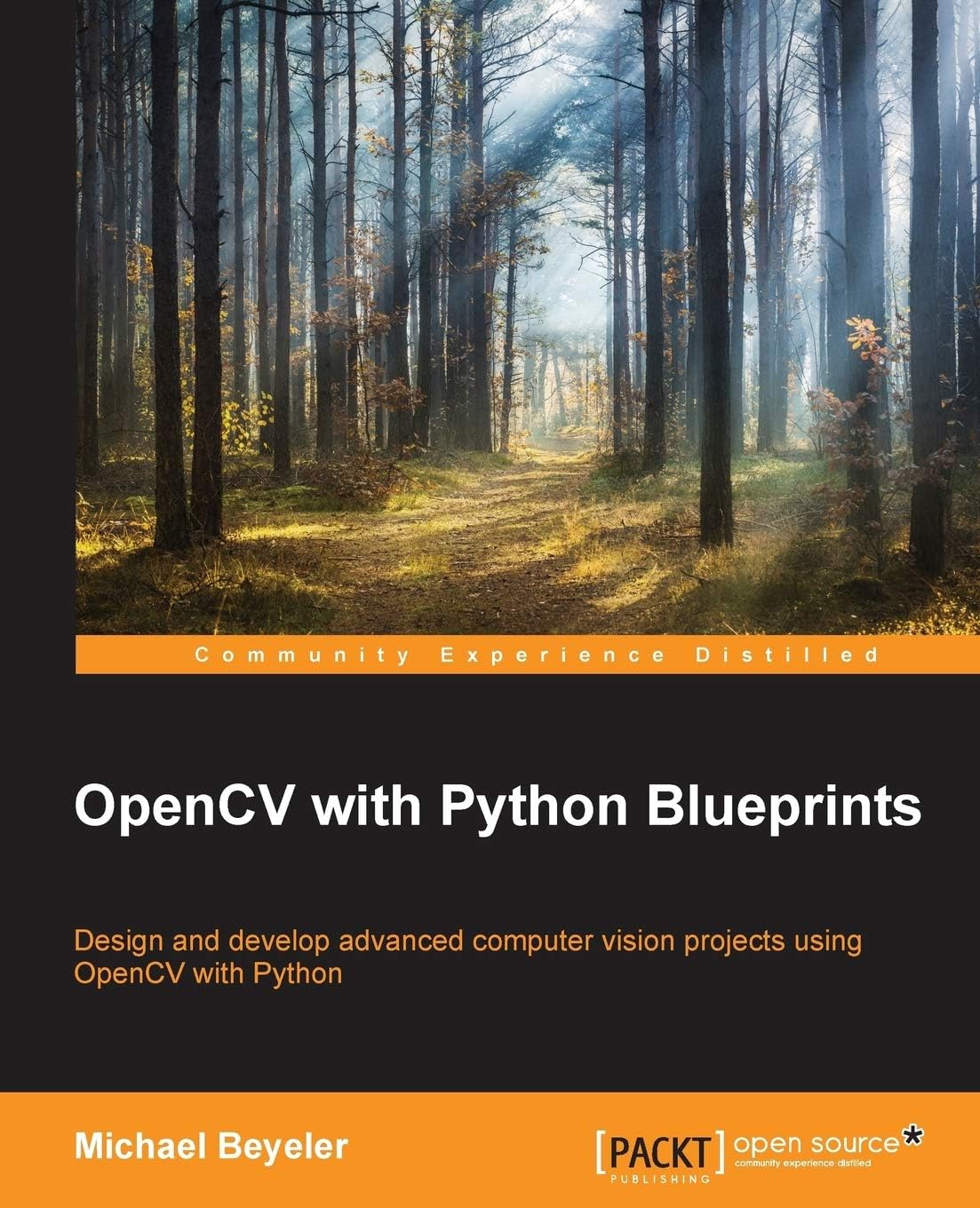
OpenCV with Python Blueprints
Product ID: 36161194
Buy anything from 5,000+ international stores. One checkout price. No surprise fees. Join 2M+ shoppers on Desertcart.
Desertcart purchases this item on your behalf and handles shipping, customs, and support to Samoa.
Design and develop advanced computer vision projects using OpenCV with Python About This Book Program advanced computer vision applications in Python using different features of the OpenCV library Practical end-to-end project covering an important computer vision problem All projects in the book include a step-by-step guide to create computer vision applications Who This Book Is For This book is for intermediate users of OpenCV who aim to master their skills by developing advanced practical applications. Readers are expected to be familiar with OpenCV's concepts and Python libraries. Basic knowledge of Python programming is expected and assumed. What You Will Learn Generate real-time visual effects using different filters and image manipulation techniques such as dodging and burning Recognize hand gestures in real time and perform hand-shape analysis based on the output of a Microsoft Kinect sensor Learn feature extraction and feature matching for tracking arbitrary objects of interest Reconstruct a 3D real-world scene from 2D camera motion and common camera reprojection techniques Track visually salient objects by searching for and focusing on important regions of an image Detect faces using a cascade classifier and recognize emotional expressions in human faces using multi-layer peceptrons (MLPs) Recognize street signs using a multi-class adaptation of support vector machines (SVMs) Strengthen your OpenCV2 skills and learn how to use new OpenCV3 features In Detail OpenCV is a native cross platform C++ Library for computer vision, machine learning, and image processing. It is increasingly being adopted in Python for development. OpenCV has C++/C, Python, and Java interfaces with support for Windows, Linux, Mac, iOS, and Android. Developers using OpenCV build applications to process visual data; this can include live streaming data from a device like a camera, such as photographs or videos. OpenCV offers extensive libraries with over 500 functions This book demonstrates how to develop a series of intermediate to advanced projects using OpenCV and Python, rather than teaching the core concepts of OpenCV in theoretical lessons. Instead, the working projects developed in this book teach the reader how to apply their theoretical knowledge to topics such as image manipulation, augmented reality, object tracking, 3D scene reconstruction, statistical learning, and object categorization. By the end of this book, readers will be OpenCV experts whose newly gained experience allows them to develop their own advanced computer vision applications. Review: Promising but takes some tweaking for some systems - I cannot get the code to work with either of the platforms I have tried. These are common platforms I would expect the code to be compatible with. Macbook Pro running OS X 10.11.5: The code in the book requires the wxPython package. The download "wxPython3.0-osx-3.0.2.0-cocoa-py2.7.dmg" simply does not install. This problem is documented and unresolved. An error message appears during install about the downloaded software not being found by the installer. Without this package the code is useless. This is not a problem with the book but without the package the book is useless. Raspberry Pi 3 with raspberry pi camera: The opencv function VideoCapture(0) does not work with the Raspberry Pi camera. So I spent a couple of days trying to get the equivalent picamera.capture in conjunction with picamera.array.PiRGBArray to work with the code by producing an equivalent numpy three dimensional array for the frame the code would work with. My syntax and data types check out but I get a runtime error "Failed to gain raw access to bitmap data." What does that mean? I am frustrated and disappointed that neither of my platforms can use the code in the book. If the book code worked with tweaking I would give it 5 stars. Update: I have finally gotten a wxPython frame to display from the pi camera on the Raspberry Pi by using the hint from G10DRAS on [...] So I am off and running and have revised my rating. Review: Solid examples with useful topics. - Solid and useful boom on getting ramped up with opencv in python. I have found it useful several times in the recent weeks as I am exploring opencv.



| Best Sellers Rank | #7,976,242 in Books ( See Top 100 in Books ) #1,555 in Computer Vision & Pattern Recognition #5,726 in Python Programming #9,920 in Software Development (Books) |
| Customer Reviews | 4.1 out of 5 stars 15 Reviews |
C**K
Promising but takes some tweaking for some systems
I cannot get the code to work with either of the platforms I have tried. These are common platforms I would expect the code to be compatible with. Macbook Pro running OS X 10.11.5: The code in the book requires the wxPython package. The download "wxPython3.0-osx-3.0.2.0-cocoa-py2.7.dmg" simply does not install. This problem is documented and unresolved. An error message appears during install about the downloaded software not being found by the installer. Without this package the code is useless. This is not a problem with the book but without the package the book is useless. Raspberry Pi 3 with raspberry pi camera: The opencv function VideoCapture(0) does not work with the Raspberry Pi camera. So I spent a couple of days trying to get the equivalent picamera.capture in conjunction with picamera.array.PiRGBArray to work with the code by producing an equivalent numpy three dimensional array for the frame the code would work with. My syntax and data types check out but I get a runtime error "Failed to gain raw access to bitmap data." What does that mean? I am frustrated and disappointed that neither of my platforms can use the code in the book. If the book code worked with tweaking I would give it 5 stars. Update: I have finally gotten a wxPython frame to display from the pi camera on the Raspberry Pi by using the hint from G10DRAS on [...] So I am off and running and have revised my rating.
B**Y
Solid examples with useful topics.
Solid and useful boom on getting ramped up with opencv in python. I have found it useful several times in the recent weeks as I am exploring opencv.
A**R
Excellent book!
Excellent book to build practical OpenCV projects! I'm still relatively new to OpenCV, but all examples are well laid out and easy to follow. The author does a good job explaining the concepts in detail and shows how they apply in real life. As a professional programmer, I especially love that you can just fork the code from GitHub and follow along. Strongly recommend to readers with basic knowledge of computer vision, machines learning, and Python!
A**W
Don't buy
Terribly sparse book with toy examples. Better off just googling things. A very poor excuse for a book. Code is just pasted in plain text. No care taken.
T**.
like object detection
This book shows how to use the OpenCV library to quickly prototype some original applications. The requirements are a PC running Windows or Linux, or a Mac, a Webcam and optionally a Kinect. Every experiment, like object detection, motion tracking and image recognition are explained in detail. After understanding the tips and tricks of each project, one can easily reuse and customize them. This book will be useful for practitioners seeking to add computer vision features to their applications.
J**B
I think it is great for a beginner to semi-advanced users
There a lot of information in this book. It is to the point. I think it is great for a beginner to semi-advanced users. Plenty of examples to help you really understand what is going on.
S**N
Great book for developing real world OpenCV applications with Python
Disclaimer: I received a free copy of the book for reviewing. OpenCV with Python Blueprints is a book for people that can write Python applications, know what OpenCV is, and want to start developing more interesting computer vision applications. The emphasis of the book is on the practical side instead of formal theory. It contains explanations about why and how the computer vision techniques work just long enough for you to understand them at a high level. This is particularly useful if you want to experiment with different areas of computer vision in a relatively short amount of time, which is exactly what this book is about. Each chapter presents a different real world project, which ranges from applying filters to an image in real time to recognizing traffic signs or facial emotions from a video feed. Here is the list of the chapter names for reference: Chapter 1: Fun with Filters Chapter 2: Hand Gesture Recognition Using a Kinect Chapter 3: Finding Objects via Feature Matching and Perspective Transforms Chapter 4: 3D Scene Reconstruction Using Structure from Motion Chapter 5: Tracking Visually Salient Objects Chapter 6: Learning to Recognize Traffic Signs Chapter 7: Learning to Recognize Emotions on Faces As you can see from the previous list, you will learn from many different areas of computer vision, such as image processing, machine learning, multiple view geometry, feature detection and tracking, object recognition, and so on. I like how each chapter starts showing the desired output of the project followed by a section called “Planning the app” where the design of the application is discussed. This is great for understanding the code that follows. The comments about the implementation are very easy to follow as well. The author does a great job explaining the concepts needed to understand what’s happening in the application without the need of going into too many details. A high level overview is provided so that interested readers can research more about the concepts used if they want to. This book is great for someone who is at a beginner level in computer vision and wants to get into an intermediate level by learning with real world examples. After finishing this book, readers will have practical knowledge about many interesting applications of computer vision, and will be able to dig deeper into any of these areas depending on their future interests.
A**R
An excellent book for all-things computer vision
"OpenCV with Python Blueprints" is a great introduction to intermediate and advanced OpenCV concepts. Technical, but not too much. It's really helpful if you want to build your own functional apps. The book focuses on the practical side of things: Every chapter describes a dedicated, stand-alone project from A-Z. I'm big on 3D scene reconstruction, so I really enjoyed the chapter about optic flow and structure-from-motion. For a book that has to cover a lot of breadth, I was impressed by how much detail was contained in just one chapter. You get a really good value here. I also liked the structure of the book a lot: At the beginning of a chapter, the author tells you the goal of the project and outlines how exactly to get there step-by-step. If there is some theory or background information you need, he will introduce the concepts and explain them using a simple example. Very easy to follow. Every chapter finishes with the finished app, so you know exactly what you'll get in the end. I highly recommend this book to anyone with the requisite background trying to get a better understanding of the more advanced OpenCV tools.
M**B
Good step by step instructions for the abysmally documented OpenCV2 ...
Good step by step instructions for the abysmally documented OpenCV2 - this book provided a nice way to learn by example. I was specifically interested in the stereo reconstruction chapter and I found the walkthrough informative and useful. I did find that I could not recreate the results in the book using the code presented but it was not too tricky to get something working from what was there. I'm sure I will revisit this book in the future - it's a good first stop in exploring the basic practical application of many techniques to computer vision.
Trustpilot
1 month ago
3 weeks ago