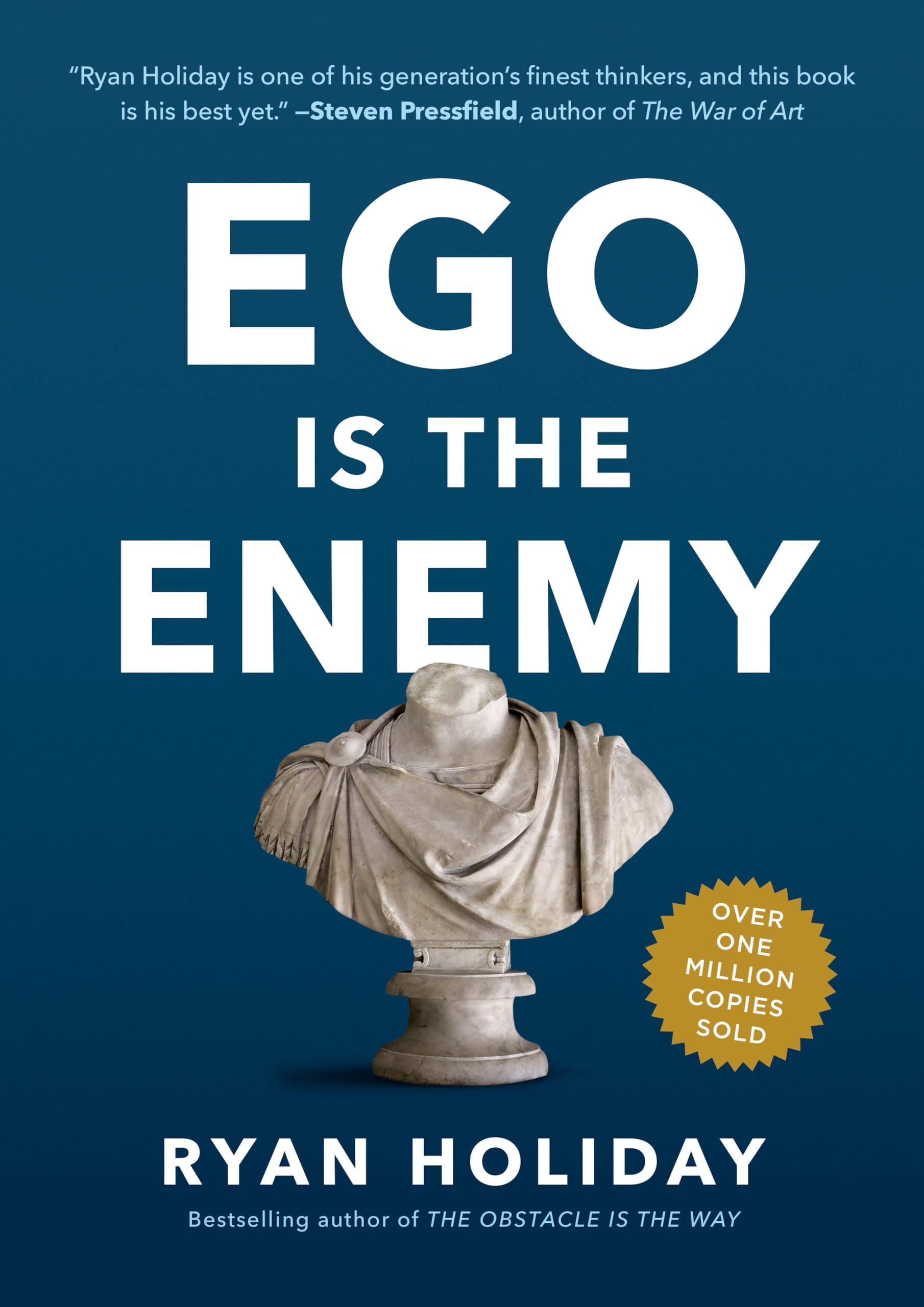
Ego Is the Enemy
Product ID: 29794737
⭐4.6/5 from 21K+ readers
🏆Top #11 in Leadership
📚Deeply researched insights
Buy anything from 5,000+ international stores. One checkout price. No surprise fees. Join 2M+ shoppers on Desertcart.
Desertcart purchases this item on your behalf and handles shipping, customs, and support to Samoa.
🔥 Ego is the enemy—master it, or be mastered.
Ego Is the Enemy by Ryan Holiday is a bestselling, critically acclaimed book ranked #11 in Motivational Management & Leadership. With over 21,000 reviews averaging 4.6 stars, it offers a compelling blend of historical and contemporary examples to expose how unchecked ego undermines success. Rooted in stoic philosophy, this book equips professionals with practical strategies to cultivate humility, enhance leadership, and foster meaningful impact in their careers and lives.


| Best Sellers Rank | #4,034 in Books ( See Top 100 in Books ) #13 in Motivational Management & Leadership #49 in Success Self-Help #135 in Motivational Self-Help (Books) |
| Customer Reviews | 4.6 out of 5 stars 21,381 Reviews |
H**Z
Well-written, Well-researched and Very Relatable
I have read many books on leadership throughout my graduate studies in organizational leadership and management, and throughout my own career in management. While this is not specifically a book on leadership or management, it has become absolutely clear that success in these fields requires an understanding of how ego affects one’s self, and others in a professional setting. What I appreciated most about this book over all the others is it’s candid approach to identifying the effects of ego on individuals, organizations, and on society as a whole. The author’s straightforward examples will repeatedly provoke the reader to recall their own real-life experiences where someone’s ego has impacted their personal or professional life. Maybe these realizations will involve past events or occurrences where the reader didn’t recognize ego as a factor until the author’s examples made comparisons to such past events so clear. Throughout the book, I found myself saying, “Damn! I did that, and it really was my ego that was running things. I should have thought it through better. It cost me....” Quite frankly, I have nothing but praise for this book, which I believe is a “must-read” for managers within any profession. It is neither oversimplified, nor overstated. In fact, the author drives his points home through multiple approaches and with a diverse array of references to historical figures and events, which exemplify both the control of ego and the lack thereof. The book is beyond a mere self-help resource, and is actually quite interesting to read. The author is obviously well-prepared and has done the reader the favor of dissecting individual, organizational and political actions through a specialized lens that ferrets out how ego has led to failure. These examples are not archaic parables, but include modern business figures, both well known and virtually unknown. Yet he does not simply call out failures of renowned egotistical figures, but offers analysis of how successful individuals chose the high ground over receiving personal praise in order to produce favorable outcomes on a much larger scale and for the greater good. Perhaps more importantly, he provides an equal number of examples were a humble individual or approach led to success on many levels. In the end, the reader will hopefully and candidly assess himself/herself, or as was the case for me, become more self-aware and see the glaring comparisons to my own past acts of egotistical actions. If one accepts the author’s many examples that support the assertion that ego holds so many of us back from our potential, then his ensuing suggestions and stoic philosophies become meaningful propositions worthy of our considerations. I did not find the book preachy or sanctimonious. I didn’t feel the author was pushing any specific dogma, but he does use the platform of stoicism as the guide here. Nonetheless, subsequent to laying out his case, the author’s pronouncemnts appear less as indictments of people, but rather the specific natural human tendency that is stronger is some of us than it may be in others: unchecked self-indulgent ego and the overemphasis on one’s own importance. The author challenges us to think back to the reason we started a career, chose a profession, accepted an assignment or launched a project. Was the purpose to feed our own egos, or did that proclivity sneak in somewhere along the way. The author aptly discusses the paradox wherein we must either choose to complete the job we originally were tasked to do, or merely to achieve recognition without truly accomplishing as much as we would have without expending the energy and capital seeking personal accolades. I found the author’s choice of content and his writing style to be inspiring, while still being very readable and relatable. I would propose that those considering this book are somehow aware that they could be affected by their own egos. Perhaps someone suggested it to them, or maybe a review or ad made them curious about how their ego might be at work. The paradox, of course, is that many people with pronounced egos will reject overtures into the examination of their own egos, as self-awareness is not a common trait among egotistical people. Hopefully, they will be motivated by some measure to start reading this book. As for me, the way I came to read the book is unimportant here, but within the first few pages, I found myself intrigued and looked forward to each reading session until I had finished. Aside from the impact it has had on me of purposefully controlling my own ego, a never-ending task indeed, the book has also launched me into seeking a better understanding of stoicism, and practicing it in my daily life. Now, as an instructor of organizational leadership, I’ve incorporated into my presentations quite a bit of the author’s teachings and even quotes from his book (because he seems to capture some points so well that I could find no renowned scholars or historical figures that said it better). I certainly hope we see more offerings of this caliber and practical utility from author Ryan Holiday.
C**R
A modern work of practical philosophy
If ego is nothing more than a Freudian concept to you, then you may not have any idea how it’s holding you back right now. But don’t think that author Ryan Holiday aims to bore us with the same stale pop-psychology tropes that most books on the Self-Help shelf use to fill out their pages. What the author has provided us is actually a great work of modern practical philosophy. Those familiar with Holiday’s last book, “The Obstacle is the Way,” will know exactly what practical philosophy means. Eschewing the commonly held view that philosophy is the province of academics in classrooms bloviating about abstract concepts, Holiday follows the Stoic tradition that puts philosophy firmly in the realm of everyday life. It’s about learning to deal with destructive emotions, unpredictable circumstances, self-interested people, and yes, ego, without succumbing to them. It’s philosophy as a way of achieving a better life. In “Ego is the Enemy,” Holiday moves beyond the clinical definitions of ego and places the concept firmly in the realm of the practical. To be sure, the clinical and the practical in this case have some common ground. Modern psychologists define the ego as a critical part of identity construction, and further, an egotist as someone excessively focused on himself. Holiday defines ego along those lines: “an unhealthy belief in our own importance. Arrogance. Self-centered ambition…It’s when the notion of ourselves and the world grows so inflated that it begins to distort the reality that surrounds us.” The idea that becoming untethered from reality is the primary symptom of an ego out of control is the thread that unites all three sections of this book. Holiday expands this idea throughout the three sections that form a continuum - Aspire, Success, and Failure - to show how this form of ego plagues everyone from the ambitious and striving, to the wildly successful and those who have been crushed by personal and professional defeat. In our own lives, we are always somewhere on that circle of aspiration, success and failure. To this end, Holiday goes right to the sources of practical wisdom: the primary sources of great practical wisdom – Seneca, Marcus Aurelius, Aristotle, and Martial to name a few - and the biographies of those who apply that wisdom to great effect or ignore it at their own peril. This is where Holiday’s other key influence, strategist and author Robert Greene, becomes apparent. Like Greene, all of Holiday’s chapters start out with a short, pithy title sets the direction of the advice contained within the chapter. From there, Holiday mines the stories of great men and women who have either applied the advice laid out in the chapter title or ignored it and shows us the consequences of both. For example, in the chapter titled, “Restrain Yourself” in the Aspire section of the book, Holiday launches right into the story of Jackie Robinson. As the first black player in the newly integrated MLB, Robinson faced discrimination and outright abuse at the hands of everyone from his own teammates and opponents, to hotel managers and restaurant owners and, of course, the press. At any point, Robinson could have lashed out, fighting back to defend his dignity against the injustices he faced. But Robinson knew that if he fought back even once, it would end his MLB career and set the prospect of full integration of the league back for a generation. As Holiday writes, “Jackie’s path called for him to put aside both his ego and in some respects his basic sense of fairness and rights as a human being.” Now, it’s likely that few of us will face the kind of treatment Robinson did, but the lesson here is that when we have ambitions and goals, we’re likely to run into the kind of people that Robinson did. The kind who react to your striving with cold indifference. The kind who aim to weaken your will with taunts and jeers. The kind who will go out of their way to sabotage you and undo all your efforts. Holiday concludes here that ego tells us to snap back at these people and demand the respect we think we deserve. But that won’t earn it from anyone. We must ignore this impulse, no matter how badly we’re treated, and continue to work on our craft and ourselves. We must forget what we think the world owes us and focus on building our base, developing our skills and continuing to learn. The rest of the chapters follow this same model, and plumb the depths of modern and ancient history to show us how those who put their egos aside achieve great things. Think of New England Patriots head coach Bill Belichick spending years doing unpaid grunt work and film study before finally getting a chance to put his knowledge into practice. Think of the great conqueror Genghis Khan seeking greater knowledge and expertise from those he defeated, rather than forcing them into silent subservience. Yet, others turn themselves into cautionary tales. Howard Hughes was a mechanical genius who inherited a successful family business, and then squandered all of it through a lack of focus, entitlement and paranoia. John DeLorean had a great vision for an automobile company, but never built the solid foundation of leadership skills he would need to run a successful company. Holiday gives us a healthy dose of both kinds of stories, and that’s what makes the advice in this book stick with us. Ultimately, practical philosophy is meant to be used in our daily lives, away from the safety of our reading chair. Holiday’s aphoristic style of advice, bolstered by memorable stories is what gives us the tools we need to remember this wisdom when our egos start to take control of us. Holiday positions the three states of our lives – Aspire, Success and Failure – as being a never ending continuum. We must put our egos aside as we aspire to our goals, aside when we achieve them, and aside again when we flame out and have to start over. At each stage, ego threatens to knock us off the continuum altogether and lock us into an unproductive state of stasis. Taming your ego is never easy, but it is essential when we are confronted by failure or bolstered by success, as we all will be in our lives. Ego can easily let both conditions become debilitating: With success, we think we can stop being humble and working hard. In failure, we can become paralyzed, blaming others for our rotten luck and ignoring the fact that it’s on us to right the ship. Ego is always encroaching on us, even after we think we’ve beaten it back. As Daniele Bolelli puts it, a floor doesn’t stay clean because you’ve swept it once; you must sweep again and again. With this short, accessible book, Holiday gives us the tools we need to do just that.
S**M
Great book
I read Ego Is the Enemy and it’s really eye-opening. It breaks down how ego can hold you back in life, work, and personal growth. The lessons take time to sink in, but if you apply them, it really helps you stay humble and focused. Not a flashy book, but definitely worth reading for anyone looking to improve themselves.
C**G
https://www.amazon.com/Brothers-Rivals-Victors-Eisenhower-Partnership-ebook/dp/B004H0M8GI/ref=sr_1_1?s=books&ie=UTF8&qid=1471163
I waited to write this review until I was able to read it from a perspective that it deserved. I have known Ryan for many years and have found myself defensive on his behalf at times. I have also dismissed a lot of his work, knowing the underlying references and material. Of course, both of those things are about me- and not Ryan at all. This book allowed me to digest things in a way that showcased a great strength of Ryan's. His ability to relate, be aware and "do the work". I'm surprised at some of the comments, only because of the apparent knowledge of the reader. It's not a facade that Ryan is an intellectual heavyweight and I thnk this book shows it most. People remember repittion most of all. They remember stories over stats. The knock that the bok says the sam thng in different way or that it is larely opnion, ansen fact, are in fact attributes. Cherry picking quotes requires skill. A qote is a fact, by defintion, and the real skill is finding te right voice to get those words across. For some it wil be Grant and others Epctitus. This opens up tangents for people who would like to dif deeper no the source auhor. This format is new and a reflecton of our times. Personnally, I find it is bize size enough to allow the simpliciy to resonae. It sources enough intellectual power that even the most jaded egomanic will have to conced to the credibility. The sklll requred to execute this should be evident, but t is not neccessary. Robert Greene deveoped a similar literary style unque to him. What I saw here has yet to be referenced, which shows me that Ryan has allowed every reader to learn ans appl in their own way. If you are familar with Ryan's work, Cognative Dssonance is one of his favorate themes. People will read ts and apply their bias, experiences and circumstances to it. If you are not a potted plant, these change. The book has living qualty to ithat makes me beleve it's impact will only grow. For those that need to a Greek philosoper to be quoted, in order to digest the point, you wll have it. What I read was a blend of excellent, but hard to digest, data fllled book shelves. I will let that do the talking: Mistakes Were Made (But Not By Me): Why We Justify Foolish Beliefs, Bad Decisions and Hurtful Acts The Medium is the Massage Sperm Wars: Infidelity, Sexual Conflict, and Other Bedroom Battles Fooled by Randomness: The Hidden Role of Chance in Life and in the Markets (Incerto) The Education of a Coach The Concise Seduction (The Robert Greene Collection) "What Do You Care What Other People Think?": Further Adventures of a Curious Character Means of Ascent (The Years of Lyndon Johnson) The Clayton M. Christensen Reader Raven: The Untold Story of The Rev. Jim Jones and His People Den of Thieves [[ASIN:B002TXZS8A The Guns of August: The Outbreak of World War I; Barbara W. Tuchman's Great War Series (Modern Library 100 Best Nonfiction Books)]] The Fog of War The Trials of Henry Kissinger Pimp: The Story of My Life Less Than Zero (Vintage Contemporaries)
I**N
your worst enemy already lives inside you
Ego is never neutral. If it is too small, you give away the farm. If it is too large, you eventually lose the farm. This superb book by Ryan Holiday, focuses on the more common affliction of the talented, ambitious and confident – an ego too large. As the book sets out to prove, your worst enemy already lives inside you: your ego. Holiday saw this unfold in slow motion with the demise of Dov Charney, founder and chairman of the huge, but failing American Apparel. He saw this unfold in his own ostensibly spectacular career, and in the careers of ancient historical personalities, as well as the contemporary ones that illustrate this sobering book. The ego he is referring to is the unhealthy belief in our own importance, our arrogance, and our self-centred ambition. It is that petulant child in every person, who chooses getting his or her way over anything, or anyone else. Holiday believes that ego is “at the root of almost every conceivable problem and obstacle, from why we can’t win to why we need to win all the time and at the expense of others.” This problem is now more acute than ever. The culture of the developed world fans the flames of ego. It has never been easier to boast to millions through free social media. Motivational speakers mislead by telling us to think big, live big, be memorable and “dare greatly”, because that is what this great company founder, or that championship team, supposedly did. Throughout the rest of your life, if you fit into the category of the talented, ambitious and confident, you will be at one of three phases: aspiration, success, or failure. In each phase you will need to do battle with your ego, and the mistakes it can cause. Holiday’s book leads the reader though each of the phases. The first is when we aspire - and whatever one aspires to, ego is the enemy. A common ego ploy is a belief in oneself that is not dependent on actual achievement, but on intense self-absorption, and endless self-promotion. “Almost universally, the kind of performance we give on social media is positive. It’s more ‘Let me tell you how well things are going. Look how great I am.’ It’s rarely the truth: ‘I’m scared. I’m struggling. I don’t know,” Holiday explains. Most valuable projects we chase are painfully difficult: launching a new start-up, or mastering a new skill. Talking, on the other hand, is always easy. While research does show that goal visualization is important, after a certain point our mind begins to confuse the visualization and the talk, with actual progress. The more difficult the task and the more uncertain the outcome, the more talk costs. Great work is a struggle. It’s draining, demoralizing, and frightening. “The only relationship between work and chatter is that one kills the other,” Holiday claims. ‘Facts are better than dreams,’ Winston Churchill asserted. Appearances deceive. Having authority is not the same as being an authority. Having the right and being right are not the same, and impressing people is utterly different from being truly impressive. The second phase kicks in when you are successful. Here the enemy of sustained success takes a different form, and requires a different response. The theory of ‘disruption’ posits that at some point every industry will be disrupted by some trend or innovation that the incumbents will be incapable of responding to. The question then is why can’t the businesses change and adapt? Holiday believes that this mimics why successful people fail – they have lost the ability to learn. Learning requires true humility and this can be seen from how people observe and listen. The humble don’t assume they know. As such, the remedy for avoiding the ‘I know it all’ ego trap in phase two, is straightforward but initially uncomfortable: “Pick up a book on a topic you know next to nothing about. Put yourself in rooms where you’re the least knowledgeable person,” he recommends. This aids the development of one ego antidote – humility. Ego fragments, closes options, and mesmerizes. It clouds the mind precisely when it needs to be clear, and a second potent solution for this is sobriety. This acts as both a counterbalance, and as a prevention method. The German Chancellor, Angela Merkel, both during her rise and especially during her time in power, has consistently maintained her equilibrium and clear-headedness, regardless of the immediate stressors or stimuli. When Russian president Vladimir Putin once attempted to intimidate Merkel by letting his large hunting dog barge into a meeting (Merkel is not a dog lover), she didn’t flinch and later joked about it. As a result, Putin was the one who looked foolish and insecure. A German writer observed in a tribute on her 50th birthday that unpretentiousness is Merkel’s main weapon. The successful, who like Merkel, maintain their equilibrium and clear-headedness, have normal private lives with their spouses. They lack pretence, they wear normal clothes, and for the most part are people you’ve never heard of, which is the way they want it. The third phase, failure, is an inevitable stop on the journey to success. “There is hardly the space to list all the successful people who have hit rock bottom,” Holiday explains. Ego not only leaves us unprepared for failure, but often contributes to it in the first place. Humble and strong people, who maintain their equilibrium and clear-headedness, don’t have the same trouble with failure that egotists do. What matters in the failure phase is that we can respond to what life throws at us. When we fail, many questions arise: how do I make sense of this? How do I move onward and upward? Is this the bottom, or is there more to come? How did I let this happen? How can it never happen again? The experience of failure almost always comes from some outside force or person, and it often involves things we already knew about ourselves, but were too scared to admit. However, from the ruin, the opportunity for great progress and improvement can emerge. “When we lose, we have a choice: Are we going to make this a lose-lose situation for ourselves and everyone involved? Or will it be a lose… and then win?” Holiday asks. Perfecting oneself is what leads to success as a professional, but rarely the other way around. To be a success, requires that we are humble in our aspirations, gracious in our success, and resilient in our failures. Studies of truly successful individuals show them to be grounded, circumspect, and unflinchingly real. No truly successful person is delusional, self-absorbed, or disconnected. “When we remove ego, we’re left with what is real. What replaces ego is humility, yes—but rock-hard humility and confidence,” Holiday concludes. This book should be read, and then re-read intermittently. Readability Light --+-- Serious Insights High +---- Low Practical High --+--Low *Ian Mann of Gateways consults internationally on leadership and strategy and is the author of Strategy that Works. .
M**J
Great Product
Great read and learned about myself from this book!
B**N
good book
Made me re-think a lot. Writing more words to post this review. Eight more words. Five more words. Two more
H**S
Thought provoking but a bit repetitive
Ego Is the Enemy by Ryan Holiday is a powerful and thought-provoking book. It’s filled with memorable stories and lessons that really make you reflect on the role of ego in success and failure. The writing is clear and practical, making it easy to apply the ideas in everyday life. The only reason I gave it 4 stars instead of 5 is that some parts felt a bit repetitive. Overall, a highly valuable and inspiring read.
D**V
Kitap söylendiği kadar Sayfa bulundurmuyor
Teslim aldığım kitap 256 değil, 226 sayfadan oluşuyor. Satış mağazasındaki verdikleri sayfa bilgileriyle hiç bir alakası yok.
J**I
Good read
I am currently reading this book. And i highly recommend this one
N**.
EGO is truly the real enemy - Love Ryan Holiday
Will have to re-read this book as he says, we need to keep sweeping the dirt every day to keep progressing in the right direction. Enjoyed this read as it is truly applicable to every aspect of my life
F**O
great book
worth reading but might get repetitive
S**A
Quality
Good
Trustpilot
5 days ago
1 month ago