We remain fully operational. Our teams are working around the clock to ensure your deliveries continue safely.

DOWNLOAD THE APP


Customer Services
Copyright © 2025 Desertcart Holdings Limited
DOWNLOAD THE APP
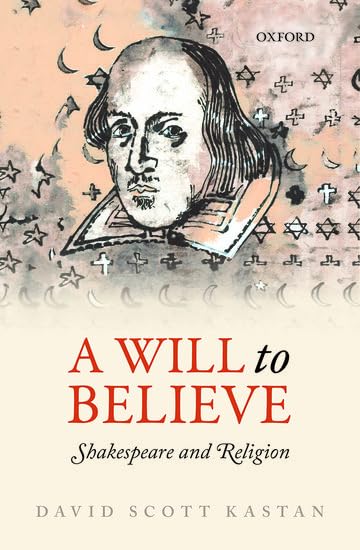
desertcart.com: A Will to Believe: Shakespeare and Religion (Oxford Wells Shakespeare Lectures): 9780199572892: Kastan, David Scott: Books Review: Welcome insights - Although far too short (I would have appreciated analysis like this for all of Shakespeare's works), a hugely valuable trove of insight into what we can know and perhaps more importantly what we can't know about the bard's personal theology. I had the incredible privilege as a drama student to sit as assistant director to the late great Charles McGaw as he directed what he and we all knew to be his last production of Hamlet, actually of any work. He spoke of first directing it decades earlier when Harvey Korman was a student and played the titular role. "He was quite good, actually." he said of him. This book helped me with aspects of Hamlet that I had not previously considered. Thank you! Review: Religion in the plays - David Scott Kastan’s A Will to Believe: Shakespeare and Religion (not, emphatically not, “Shakespeare’s Religion’) is yet another well-informed, imperceptive riff on the Rorschach Shakespeare. I read only his pages on King John and The Merchant of Venice (he treats only four plays at any length; the others are Othello and Hamlet), but they are enough to demonstrate his unsubtle eye. KJ is examined in light of Bales’s play rather than the Troublesome Reign and, as is usual with solely verbal analysis, extracts only a few passages to make its case, with no sense that the plot is the argument or that structure makes its own comment. Rather, Kastan looks to Colley Cibber’s adaptation and to the interesting but irrelevant fact of an expurgated text for Catholic seminarians to guide his reading. “The frustrating ambivalence of Shakespeare’s play” is the take-away here, as it is in so many recent critical evasions. And in Merchant too he sees only the surface topics—Jewishness, usury, genre—and does not see the nexus of money and flesh or the existential issue of identity. These kinds of readings demonstrate, by their very blinkers, by how much they miss, how subtle Shakespeare actually is, how crucial it is to have an understanding of the overall design of a play, a meaningful context for the extracted passages, and a sense of the changes in the characters as the play progresses. (Kastan gives no hint that King John changes in the course of the play and that his early defiance of Pandulph is a point of departure rather than a terminus ad quem.) Consequently, Kastan’s stated aim—“to engage the question of what religion is doing in these plays”—is only superficially fulfilled, because he has a priori decided that although “[t]he plays…clearly assume a world in which God is immanent…that immanence is not their subject.”


| Best Sellers Rank | #8,431,603 in Books ( See Top 100 in Books ) #660 in Shakespeare Literary Criticism #1,223 in English Literature #1,259 in Shakespeare Dramas & Plays |
| Customer Reviews | 4.4 4.4 out of 5 stars (6) |
| Dimensions | 7.9 x 0.8 x 5.5 inches |
| ISBN-10 | 0199572895 |
| ISBN-13 | 978-0199572892 |
| Item Weight | 10.2 ounces |
| Language | English |
| Print length | 168 pages |
| Publication date | March 9, 2014 |
| Publisher | Oxford University Press |
M**R
Welcome insights
Although far too short (I would have appreciated analysis like this for all of Shakespeare's works), a hugely valuable trove of insight into what we can know and perhaps more importantly what we can't know about the bard's personal theology. I had the incredible privilege as a drama student to sit as assistant director to the late great Charles McGaw as he directed what he and we all knew to be his last production of Hamlet, actually of any work. He spoke of first directing it decades earlier when Harvey Korman was a student and played the titular role. "He was quite good, actually." he said of him. This book helped me with aspects of Hamlet that I had not previously considered. Thank you!
J**N
Religion in the plays
David Scott Kastan’s A Will to Believe: Shakespeare and Religion (not, emphatically not, “Shakespeare’s Religion’) is yet another well-informed, imperceptive riff on the Rorschach Shakespeare. I read only his pages on King John and The Merchant of Venice (he treats only four plays at any length; the others are Othello and Hamlet), but they are enough to demonstrate his unsubtle eye. KJ is examined in light of Bales’s play rather than the Troublesome Reign and, as is usual with solely verbal analysis, extracts only a few passages to make its case, with no sense that the plot is the argument or that structure makes its own comment. Rather, Kastan looks to Colley Cibber’s adaptation and to the interesting but irrelevant fact of an expurgated text for Catholic seminarians to guide his reading. “The frustrating ambivalence of Shakespeare’s play” is the take-away here, as it is in so many recent critical evasions. And in Merchant too he sees only the surface topics—Jewishness, usury, genre—and does not see the nexus of money and flesh or the existential issue of identity. These kinds of readings demonstrate, by their very blinkers, by how much they miss, how subtle Shakespeare actually is, how crucial it is to have an understanding of the overall design of a play, a meaningful context for the extracted passages, and a sense of the changes in the characters as the play progresses. (Kastan gives no hint that King John changes in the course of the play and that his early defiance of Pandulph is a point of departure rather than a terminus ad quem.) Consequently, Kastan’s stated aim—“to engage the question of what religion is doing in these plays”—is only superficially fulfilled, because he has a priori decided that although “[t]he plays…clearly assume a world in which God is immanent…that immanence is not their subject.”
S**A
I loved this book
I loved this book: it was smart, sensitive, sensible, and often surprising. Instead of some form of special pleading about Shakespeare, claiming him as a fellow traveler, this gives you a sense of how religion actually matters in the plays, without losing the sense that they are plays rather than polemics. The readings of Shakespeare are subtle and compelling; the information about religion and politics in the period is scrupulously scholarly. The book is wonderfully readable (and occasionally funny). This is an important book that appropriately has received wonderful reviews in the British newspapers. The cranky review on Amazon admits it only read about 25 pages. Read it all. It is terrific.
A**R
I would liked to have known what Scott Kastan thought about the subject than rather what he thought about what other people thought.
Trustpilot
1 month ago
4 days ago