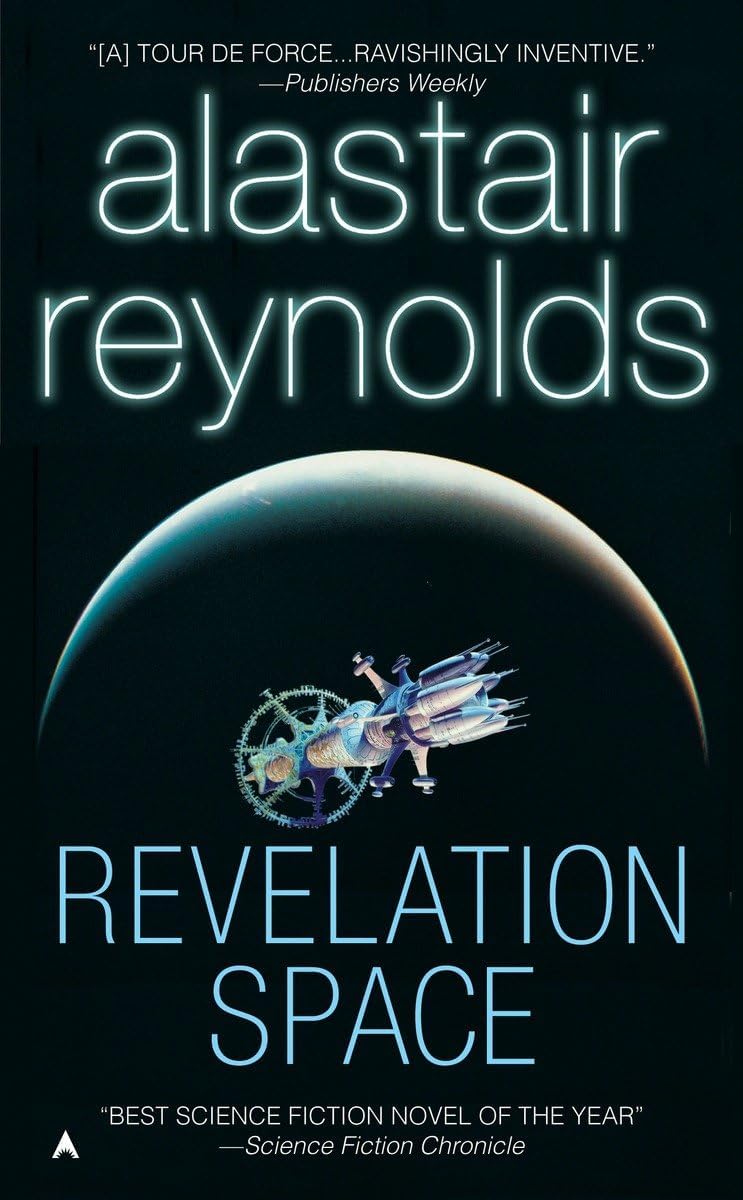
Revelation Space Mass Market Paperback – May 28, 2002
Product ID: 17060527
Buy anything from 5,000+ international stores. One checkout price. No surprise fees. Join 2M+ shoppers on Desertcart.
Desertcart purchases this item on your behalf and handles shipping, customs, and support to Samoa.
Full description not available
T**N
Weak start, but story improves and grows on you.
Initially I was a bit disappointed by this novel, that by now is regarded a "modern classic". The story is slow to start, and sometimes seem unnecessarily complicated, and also a bit clicheed with regard to some of the transhumanist themes (though that probably wasn't so, back +20 years ago, when it was written). The story does however grow, and improves as it progresses. By and large a great read in the end, but some of its characters are a bit cliche, and while the story is branded as "hard Sci-Fi" and written by an astrophysicist, I wouldn't call it particularly "hard" (though not very "soft" either). Just because there is no FTL travel featured, doesn't automatically make a Sci-Fi "hard". But an enjoyable and interesting story nonetheless.
R**E
A lot of buildup and a rushed ending.. nevertheless a very good story.
First and foremost, this novel rewards those who stick it out. There's a big idea at the center of it and the story is built around the Fermi Paradox (which in a nutshell asks why the galaxy isn't teeming with thousands of interstellar civilizations - or in other words, why can't we easily find them).It takes awhile to begin to understand what the novel's about however, and it's not helped by the way the author starts from three separate points of view in three different time periods, all of which come together about midway through the book. Additionally, there are numerous references to other events even further back in the past, which have a huge impact on the future. Even though I don't require plots to be extremely straightforward, I feared I'd be lost or forget crucial information when it was necessary. Fortunately, the author 'summarizes' a lot, and does so in relatively natural ways (usually characters talking to each other). One nice thing about the three different starting points is that it shows the effects of relativity in a very clear and easily understood way, without actually going into the physics of it. For someone who understands the basics of relativity, and how velocity can affect time, it's well done, but if someone doesn't understand relativity they might be a bit confused.One thing the author did which always drives me a bit nuts, is to have a character suddenly understand a lot more than the reader, but the reader is still left in the dark. One character, at one point obviously gets let in on a major revelation but the reader doesn't hear the explanation related. This character later tells another character, and again the explanation is not directly relayed to the reader. I understand that the author wanted to make a big reveal later, but this kind of thing annoys me to no end. Fortunately, the book itself was good enough to overcome this problem.The 'revelation' at the end does tie the main story up quite neatly, although there are certainly one or two fringe loose ends. It even makes things characters do earlier in the book have a bit more context. It's clever but not really mind blowing.The writing style is well done, pretty straightforward (except for the jumps in time), and evocative. The characterizations are pretty good but somewhat on the 'generic' side. The universe appears to be an interesting one, but that's not really the point of the novel. The author probably knows his universe inside and out, but only tells us the bits important for the novel itself, and I like that style a lot (certainly more than the 'Gotta make sure the reader understands everything about the universe even if they only need to understand 1% of it for the plot to make sense' method that other writers use).All in all, it was an enjoyable novel. It asked the kinds of questions I like to ask, and came up with reasonable answers to them. The structure makes the book a bit difficult to get into, but the author makes sure you never forget the important details. Definitely recommended.
A**E
Simple Story well told
Simple Story mystery well told .The torqued arrogant hero finds redemption. The author weaves a tell of technology goneamuck.
V**K
Imagination run free!
Good sci fi, atleast in my mind, starts with creating a world where the reader's imagination can run free (and no, marines carrying plasma weapons and fighting aliens, fun as it may be, isnt true sci fi). Peter Hamilton's Commonwealth is one such world. Iain Bank's Culture is another. Alastair Reyold's recreation of the future also tries to create a world with some recognizable elements and yet which is truly different enough to inspire wonder in the reader.The world-building is creative and unique - humanity's factions means that technology isnt as uniformly distributed (so you have space travel combined with near-rustic colonies that depend on wandering trading ships for technology). The stories take into account time dilation due to near-light travel (something Vernon Vinge does very well in his books as well), whihch adds a sense of realism and also scale/scope to the story. And of course, the whole Dawn War concept is flat-out brilliant, both in terms of the audacity of its scope (a history that spans billions of years) and also in terms of giving the reader just enough information to fire their imagination.What lets this book down a little, in my opinion, is the pacing. I dont mind slow reads - Pandora's Box/Judas Unchained (Hamilton) start out slowly as well, but the immersion into that world is so captivating that one remains mesmerized, and the action builds up to a seat-of-the-pants crescendo that is oh-so-immensely satisfying. This books falls a little short, in my opinion, hence the 4 stars.For starters, while the world-building is really interesting, it isnt woven as tightly into the narrative except in a couple of places - yes, there are references to implants, yes the lighthugger arc is quite nice, but it isnt as *cohesive* as in Hamilton's or Bank's books. With such a drastic evolution of humanity, you would think beliefs, behaviors, values, etc would also change, but that isnt reflected in the story. You have marriage, you have coups, you have imprisonment - all fairly prosaic and, but for the setting, behavior that would be normal in today's world. Yes, I realize that human nature is going to be somewhat consistent - but surely, when you have Ultras, Conjoiners, etc., and a world with such different degrees of technology, you'd expect some greater differences in behavior and social structure.The other part is that finale of the book seems better suited to a movie - long descriptions which, after a while, lose their impact due to repetition. It doesnt help that the threat needed to rachet up the drama of the ending wasnt developed well enough, so that seat-of-the-pants experience is missing (although it is offset to some degree by the sense of impending discovery).Lastly, the author - who writes very well for the most part - seems to randomly drop into detailed recaps of events that had happened in the earlier part of the book: tactics that would make sense if this were the 2nd or 3rd book of the series and he was referring to something in Book 1, but which feel a little awkward when referring to something a few chapters earlier.If I come across as being overly-critical, that isnt my intention - it is merely to explain why I havent given this book a 5-star rating: i tend to keep 5-star ratings for truly special books, and while I wont call this "truly special", I will call it very good, and recommend it highly. I really liked it, and have just purchased not only the next 2 books in the series but all the other works set in Revelation Space.
Trustpilot
1 month ago
3 days ago